Sneakerpharm: Perfect Imperfection
Perfect Imperfection
By Liam Wilson and Molly Granger
“I’m like, a hyper consumer. I’m the guy who likes lore. You know, it’s crafted by a 100-year-old, by his hand, took him 50 hours to do.” We’re chatting to Vinnie Tao, the founder of Sneakerpharm. While most of us will care for our clothing and maybe even get it tailored to extend its life cycle, we’re unlikely to do much beyond chucking our latest pair of trainers in the bin once they’re worn out.
While the idea of caring for your clothes, mending and wearing over and over, has entered most of our minds recently, how much thought do we put into our trainers? Most likely, they will get chucked in the bin once they’re worn out.
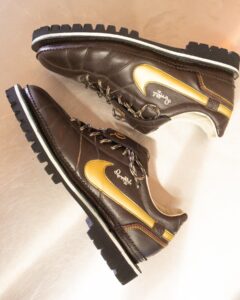
This is exactly the sort of attitude Vinnie and Sneakerpharm are seeking to change, with Vinnie’s shoe care boutique offering an array of services to look after your shoes. Think: cleaning, stitching, repainting, as well as more creative restorations, like re-soling and reconstruction. Making your shoes last longer doesn’t sound particularly exciting, but the results can be quite fun: if you saw the viral part-Umbro football boot, part-brogue that circulated online last year, that was Vinnie’s work.
The First Foray
Prior to founding Sneakerpharm, Vinnie had followed a more conventional path, working in a corporate job, studying international business, and later completing a law conversion. His impetus for change? “Being really fed up with what I was doing,” he says. Why was that? I ask. “There was no creativity,” Vinnie tells me.
Sneakerpharm is his first foray into the fashion industry, but he had all the experience he believed he required: an understanding of what was going on in the market and a genuine love for sneaker culture. “I remember back in like 2010, 2011, I was just browsing websites like Mr. Porter and End Clothing,” he recalls. What began as a hobby soon evolved into a deeper insight into the future of footwear. “The more you looked online, the more you kind of know what’s coming along,” he explains.
Immersed in sneaker culture during its peak, when designers like Kim Jones and Virgil Abloh were collaborating with Dior and Nike, Vinnie saw a unique opportunity. “This is really exciting, like from the outside,” he remembers thinking, a feeling that quickly transformed into “a way to be like, oh, I need to do it.”
Launching a business with a singular vision in an industry steeped in tradition comes with its own set of challenges. Starting with just £3,000, no backup plan, and an 8m x 10m shipping container, Vinnie took a leap that most would approach with caution:
“I don’t know what spurred me on; it was just like the spirit of adventure, kind of like doing something that I hadn’t done before.”
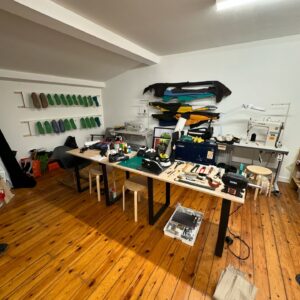
Manchester might not be the obvious choice for launching a specialist restoration and reconstruction service, but for Vinnie, it was essential. “I’m born and bred here, like I rep Manchester, but it’s a bit far behind from a fashion perspective,” he says. He could have easily set up in London, where these ideas are more readily understood, but that wasn’t the point.
He remembers spending what he terms “a stupid amount” on shelves because he saw them as a reflection of himself. “So that when people walked into the shop, they would be like, ‘oh, this is Vinnie’s shop’.” It’s a testament to Vinnie’s philosophy of buy less, buy better.
Starting out with “just two Ikea trays” and “really nice shelves which do nothing” was bound to raise questions from those closest to him. “Even now I do this, and people are like, ‘What is it? Like, I don’t; I don’t get it,’” he admits. But in Vinnie’s eyes, that confusion is part of the process, the need is created through novelty and creative approaches to educating consumers.
Embracing Imperfection
A key inspiration for Sneakerpharm’s approach is the Japanese concept of Wabi-Sabi, an acceptance of imperfection. In contrast, Western consumer culture often leans heavily into newness, driving overconsumption and a lack of appreciation for the things we already own. One of the biggest culprits? A trend-first mindset. As Vinnie puts it: “It’s the reason why people throw things away and enjoy something one month and not the next because everyone else is not wearing it.”
This mindset presents a challenge from a business perspective, but it’s one Vinnie is actively working to shift. “Most of my customers go, ‘Oh, can you make this like, exactly like it was? Because I love this design.’ That’s the thing with most consumers; they like to stick to what they know. Like it looks like a shoe they recognise. They’ll never deviate from it. If there’s a slight difference in it, they’re not going to like it,” he explains.
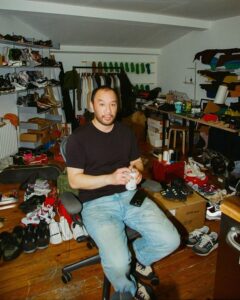
This idea of embracing difference and imperfection is central to Sneakerpharm’s philosophy. Vinnie takes a creative approach to reimagining traditional footwear, whether it’s swapping out a plastic tab for a leather patch or fitting a trainer with a Vibram sole. But not everyone is ready for that kind of change.
“I could swap this for a Vibram sole and switch it up a bit,” Vinnie says. “And people are like, ‘nah, I’m just going to throw these away,’ even if they are alright on the upper and it’s just the sole that’s gone.”
Still, restoring a shoe to its original condition isn’t always practical. As Vinnie explains, the only way to achieve that level of precision is by purchasing a new pair and swapping the sole, an option that raises concerns around cost and highlights the limitations many face when trying to adopt more sustainable habits.
“I think consumers have just the same amount of responsibility as big companies, because consumers ultimately have the power,” he says. For Vinnie, education plays a crucial role, not only in promoting sustainability and better-quality footwear, but also in helping people feel confident wearing something that doesn’t look exactly like everyone else’s. “How do we communicate this to consumers?” he asks. “Just educate them on what’s good.”
Corporate Responsibility
A major part of the responsibility, Vinnie argues, lies with big businesses. Having sat in meetings with Nike, he’s seen firsthand that major brands are beginning to consider sustainability. Still, he questions whether they’re making enough meaningful changes, something he’s been actively pushing for.
Brands, like Ganni, 3sixteen and Mfpen, are already integrating sustainability into their business models. But for legacy giants like Nike and Adidas, short-term costs, quarterly targets, and shareholder interests make it unlikely they’ll embrace changes that don’t immediately benefit the bottom line. Vinnie points out that in large corporations, “there’s not one person, with sprawling teams, responsibility becomes easy to deflect, after all it’s easy to say you can’t do anything about it if your team has another 30 people on it.”
To help tackle overconsumption and encourage more sustainable habits, Vinnie believes regulation is key. “It would change the game completely if there’s a right to repair in Europe, with regulations to do that.” Such legislation would allow consumers to access parts needed to restore their footwear independently, rather than relying solely on manufacturers.
“If you buy a car and the exhaust falls off, you’re not going to buy a new car to swap the exhaust, you would just buy an exhaust, right? Why don’t you with shoes?”
Best-Case Scenario
It’s a best-case scenario, but over time, initiatives like this could significantly shift consumer attitudes. Vinnie acknowledges the optimism behind the idea, “Maybe I’m dreaming, but that would be the case.” In the meantime, he stresses the importance of recognising consumer power in influencing corporate behaviour. He points to Nike’s recent troubles and the rise of challenger brands like Hoka as evidence that change is possible.
The cycle of consumption, he explains, is driven by fleeting satisfaction, “The dopamine hit that you get when you find one thing, then it wears off and you’re onto the next dopamine hit.” For Vinnie, this is exactly what people need to start thinking about.
There’s also the issue of intellectual property (IP), particularly in footwear. Vinnie explains that while it’s difficult to secure IP rights for clothing, shoes are a different story, there’s more proprietary technology involved, like Nike’s air unit, making them more protected. Access to spare parts could make repair more affordable and extend the product lifecycle, but it raises concerns around exploitation. As Vinnie puts it, “The issue then becomes that people could exploit it and make stuff.”
Whilst progress on sustainability legislation has been slow, often hindered by corporate pressure. Vinnie notes that decisions tend to prioritise economic metrics over environmental impact: “All the decisions so far have gone something like, ‘We don’t want to affect GDP. If we do this, we want to make sure that businesses don’t suffer.’”
Good Design Wins
A concept that Vinnie tries to apply to purchasing is something he calls the “endgame thing”, an aspirational product that, once reached, signals completion. “Once you get to that point, it’s like, done. I’m not going to get another one.”
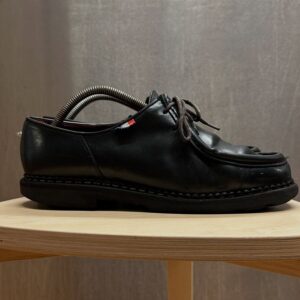
He’s drawn to products that aren’t necessarily marketed as sustainable but are by nature. One example is French shoemaker Paraboot, made by hand with a structure that allows for repair. Vinnie notes that while people are becoming more conscious of what they buy, many still lack clarity, often defaulting to cheaper options. “People are considering what they’re buying more, but don’t necessarily really have a clue of what to buy, so you go for cheaper stuff.”
The problem, he says, is that there’s always a compromise. Cheap products often lack durability, while luxury items can be delicate. In his view, “there’s never going to be a perfect shoe,” but that doesn’t mean we shouldn’t be more thoughtful in our choices.
Of course, not everyone can afford their “endgame” product, especially in the current economic climate. The rise in vintage and second-hand footwear offers a viable alternative. Vinnie observes that “there used to be a kind of stigma” around buying second-hand shoes, but even people he wouldn’t expect are now embracing the shift away from box-fresh products.
Beyond The Boxfresh
Educating consumers isn’t without its challenges, but Vinnie remains optimistic about the future of the industry. He believes the next generation is already wired for sustainability, describing them as “the future” with “the mindset of sustainability-built in.”
For those already working in fashion, the reality is clear: the market is struggling. But Vinnie sees this instability as a catalyst for innovation. It’s a moment, he says, that “promotes change”, a chance to rethink how things are done.
It was clear throughout our conversation that Vinnie hopes this shift in generational attitudes, combined with the pressure of a changing market, will push the industry toward more meaningful transformation. That means moving away from mass production and towards “constant innovation and not just churning out product to sell.” It also means asking better questions: “How do we give our consumers more? As well as transparency.”
Vinnie sees consumers playing a bigger role in this change, taking action, challenging norms, and asking questions. It’s a shift that opens space for new ideas and approaches.
“The state of fashion is exciting,” he says, “because people, more the big boys, are being challenged by the small.”
Today, Sneakerpharm has grown to include a cleaning solution developed over five years, alongside a continually evolving toolkit for sneaker restoration. It’s a business built on care, creativity, and a belief that change is possible. And as Vinnie reminds us, the answers to fashion’s biggest problems might already be within reach. “You can always have fun with it too.”