How Emerging Brands Like Kemi Gbadebo’s GBADEBO are Redefining Sustainable Fashion
By Bhagya Sadashiv and Morgan High
Fashion is one of the biggest causes of global pollution, responsible for 10% of global carbon emissions and nearly 20% of wastewater. Household names like Stella McCartney and Eileen Fisher have long championed sustainability at scale. But beyond the big brands, a quieter shift is taking place, led by small, design-driven labels that are building slower, more intentional fashion networks.
These emerging brands are guided by founders with vision, creatives who see fashion not just as a product, but as a platform for change. Kemi Gbadebo is one of them. The Spanish-Nigerian designer behind GBADEBO is reimagining streetwear through the lens of heritage and sustainability. Her work fuses upcycled materials with heritage-inspired streetwear design, offering clothes but also a movement for systemic transformation, driven by ethics, and a respect for the planet.
From Wardrobe to a Sustainable Movement
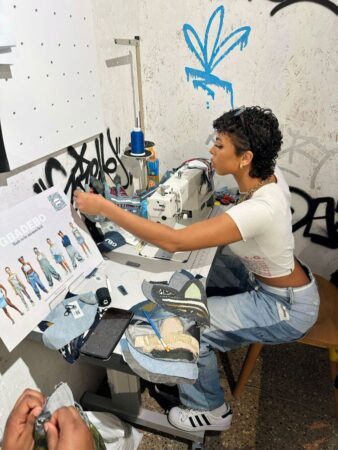
Kemi’s journey into fashion began in April 2020 during the lockdown. With fabric stores closed and no way to order materials, the then-university student turned to her own wardrobe, deconstructing old pieces to create something new. What began as a way to pass time quickly evolved into a brand with purpose. “I just needed a bit of stimulation in lockdown, then it became a hobby, then a business,” she recalls. “My mum started posting on Facebook like, ‘Has anyone got any old clothes they don’t want anymore?’… I’d sort through them all, wash them, make them into new stuff… even now I still get a couple pieces of denim here and there.”
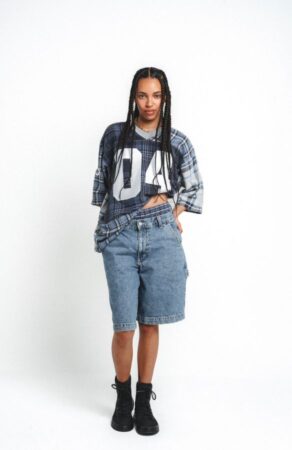
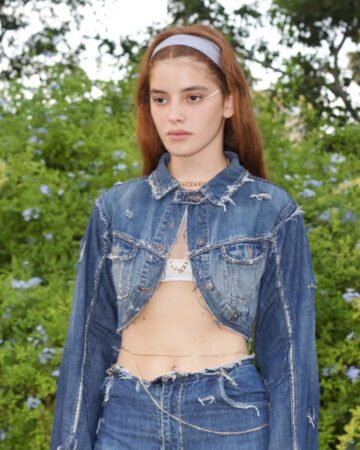
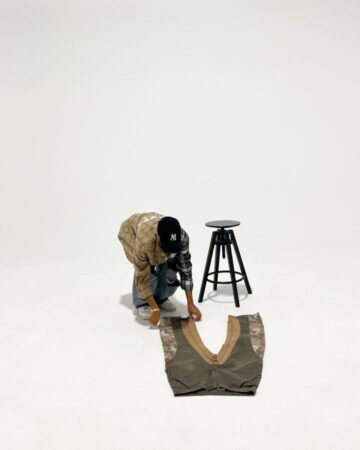
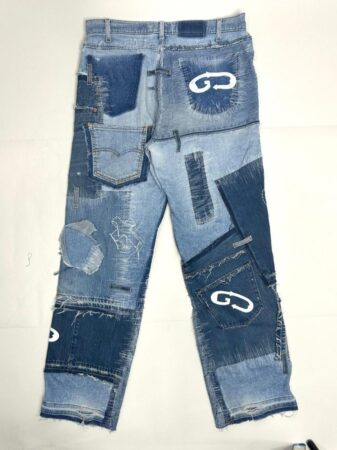
Kemi’s unique selling point for Gbadebo lies in her innovative approach to garment design, rooted in the deconstruction of existing pieces. Favouring denim as a signature fabric, Kemi specialises in reworking patches of material from deadstock clothing to create new designs. Heavily inspired by 90s hip hop streetwear, her brand fuses nostalgic street style with a contemporary streetwear edge.
During lockdown her instinct to reuse what she had sparked a movement she hadn’t anticipated. What started as a creative outlet soon gained traction when she shared her one-off designs on Instagram. “People were asking where they could buy my pieces, so I put them up on Depop.”
She recalls the first ten items selling out in minutes. After making 30 more, these were sold in an hour. “I wasn’t even thinking about sustainability, I was just using what I had. But when people began labelling my work as sustainable, I dived in and discovered how deeply I cared. That was the turning point.”
Kemi explains that when she used to think about sustainability, she would always think of burlap sacks, browns and greens — a far cry from her own aesthetics. “For me, upcycling and sustainability are about being whimsical. It’s meant to be fun, and that’s the way I want to show you sustainability.” She notes that timing was key: she established her brand just before many sustainability brands started. While Depop was where she began, she realised that to be taken seriously as a brand, she had to find audiences elsewhere, too.






The Breakthrough
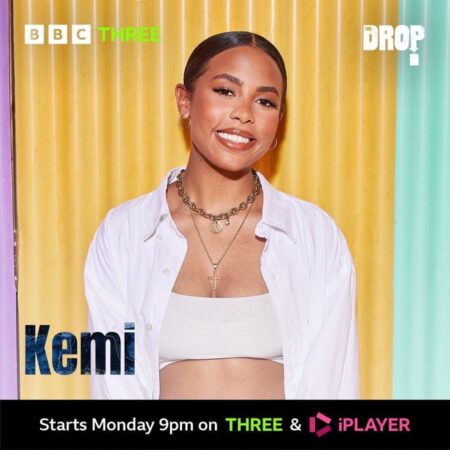
Her breakthrough came when she was selected to compete in The Drop, a BBC streetwear competition. “Every single episode felt like a challenge to prove the validity of my business,” she says. Citing her time as the show as a real opportunity for growth. Kemi recalls having to make clothing, create a business plan and design shoes in one short period. “I didn’t feel like I had a business yet, but the experience forced me to build one.” By the end of the competition, Kemi had developed a clear vision for her brand and went on to win, securing a contract with Flannels to produce a collection. She now collaborates with a Manchester-based manufacturer, staying closely involved at every step as demand soared, Kemi’s production process evolved.
Scaling a brand is rarely seamless, and for Kemi, it was a leap from piecing work together at home to mass production. “I was literally making stuff in my dining room, and then I’m being asked to manufacture like 500 units… with what money?”. The transition was not just logistical for Kemi, it was emotional. “I didn’t anticipate how much was going to go into it,” she confesses. Every decision, from sourcing ethical fabrics to ensuring fair wages, became a test of her values and resilience.
Despite the constraints, her commitment to sustainability remains at the forefront. For Kemi, sustainability should always be playful and expressive. We can see this through her unique collaborations with major brands like Ellesse, Adidas, and The North Face, collaborations she’s used as creative laboratories to grow her ideas.
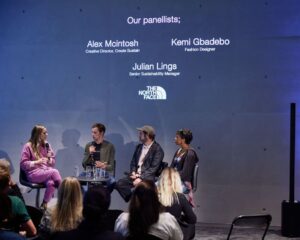
Her first partnership with Ellesse came while she was still at university. “They sent me a massive box of clothes, and I just got to rip them apart,” she says, “It gave me a whole other role… almost like consultancy.”
As she works on her upcoming collection, she is excited to return to her roots in upcycling. “This collection is going back to be all about better silhouettes, better quality, and more of the upcycling that I love. It’s exciting, and it’s coming soon.” For Kemi, GBADEBO is more than a fashion label, it’s a living archive of her heritage. “The brand is basically like an embodiment of me and what I love,” she says.
Activism, Outreach, and Policy Change
Her Spanish and Nigerian roots are woven into every garment, from catwalks in Majorca to the textures inspired by her grandfather’s artwork. “I wanted to adopt the language of my granddad’s art in my design style,” she explains. Each piece is a tribute to lineage, memory, and cultural storytelling.
Yet after speaking with Kemi, it was clear that her impact extends beyond her brand. Deeply rooted in this city’s creative ecosystem, she collaborates with local organisations like Manchester Fashion Movement and Factory International, entrenching herself in city wide activism and community organisations. In doing so, Kemi has become a figurehead for slow fashion in Manchester.
In a powerful moment of advocacy, Kemi was invited to speak at a Westminster roundtable on the future of the British high street in 2024. There, she made a compelling case for supporting independent brands by transforming empty retail spaces into opportunities for small businesses. She argued for reduced business rates, rent-free access, help with bills, and government funding— “just something to support independent brands and actually fill those empty spots,” as she put it.
Championing the idea of giving independent brands a foothold in retail environments, traditionally dominated by fast fashion, her message was clear, sustainable fashion needs space to thrive. “I spoke a lot about the different workshops that I do and the importance of sustainable brands and giving them spaces,” she adds.


On the future of GBADEBO
It is clear by the end of our interview that Kemi is a is a one-woman powerhouse. “If I’m not working, there’s no work being produced. There’s no money being made,” she says, candidly exposing the relentless pressure of being a solo founder. Success doesn’t always come with ease. After graduating and becoming a parent, Kemi faced the challenge of maintaining momentum. “I did not want to be sewing… but when you’re the only one running your business, if you’re not working, there’s no work being produced,” she says. The pressure was real, and so was the fatigue. From sourcing materials to designing, manufacturing, and marketing, every stitch is a product of her labour. “It’s just me making stuff… hopefully building a team will come in time,” she adds.
Kemi is clear-eyed about the future of GBADEBO. While pop-ups and market stalls served their purpose, she’s now focused on elevating the brand. “I don’t want it to look crusty…I need to figure out ways to level up,” she says with conviction. Her strategy is deliberate: she plans to keep her business online and grow it enough there to eventually move to bricks and mortar. As she plans to scale GBADEBO, Kemi remains committed to staying true to her core values. “Expanding is exciting, but I want to do it in a way that aligns with my principles.”
Kemi Gbadebo’s advice now for students who are looking to found their own brand is refreshingly simple. “Don’t worry about trying to find the perfect name or logo… it’s actually not that deep,” she says. Her journey is a testament to the power of momentum and self-belief. “You need to start somewhere, and someone will say yes,” she encourages.
Emphasising the importance of action over perfection, she encourages aspiring designers to dive in, no matter where they are in their journey. “If there’s a brand or person you want to work with, just reach out,” she advises. From sending cold call emails to LinkedIn messages, her career has been built on bold outreach and the courage to ask.’’ You’d be amazed at how many opportunities come from a simple ‘yes.’”